Why Georgia suits a first visit
In Georgia, a single day can hold a stone church, a mountain road and a long meal, and none of them feels hurried. The country is small, and the Caucasus, the great mountain range between the Black Sea and the Caspian Sea, rises within a few hours of vineyards, river valleys and a warm subtropical coast. Visitors can therefore build a trip around one base or move between several, without long and tiring journeys.
What gives the country its character is not only the scenery but also the hospitality that surrounds it. Meals are generous, conversation is unhurried, and even a short stop in a village can turn into an afternoon.
Top sights in Tbilisi
Tbilisi, the capital, sits in a river valley, and its old quarters climb the slopes like a staircase of balconies. In the Old Town, narrow lanes pass carved wooden verandas, small churches and quiet courtyards. Nearby, the Abanotubani district is known for its sulphur bathhouses, whose low brick domes rise from the street.
The Peace Bridge, a curved pedestrian bridge of glass and steel, crosses the Mtkvari River beside Rike Park. From the park, an aerial cable car rises to the Narikala ridge, where the paths and terraces give wide views over rooftops and domes. Further along the ridge, the statue of Kartlis Deda, the Mother of Georgia, watches over the city from Sololaki hill.
Rustaveli Avenue is the capital’s formal boulevard, lined with theatres, museums and cafés. Sameba Cathedral, the large Holy Trinity Cathedral, stands on a hill on the opposite bank. Mtatsminda Park, a hilltop amusement park reached by funicular (a cable-hauled railway for steep slopes), suits families and anyone who wants an evening view of the city lights.
Day trips and regions beyond the capital
Mtskheta, the ancient former capital, lies a short drive north of Tbilisi. Its historic monuments are a UNESCO World Heritage Site. Svetitskhoveli Cathedral anchors the old town, while Jvari Monastery stands on a hilltop above the meeting of two rivers. Both are active places of worship, so covered shoulders and knees are expected, and a light scarf is useful.
Kakheti, in the east, is the main wine region. Wine here is traditionally made in qvevri, large clay vessels buried in the ground. Even visitors who do not drink wine will find the region rewarding for its monasteries, orchards, walled towns and views toward the mountains. Family cellars are also good places to learn about local bread, cheese and village life.
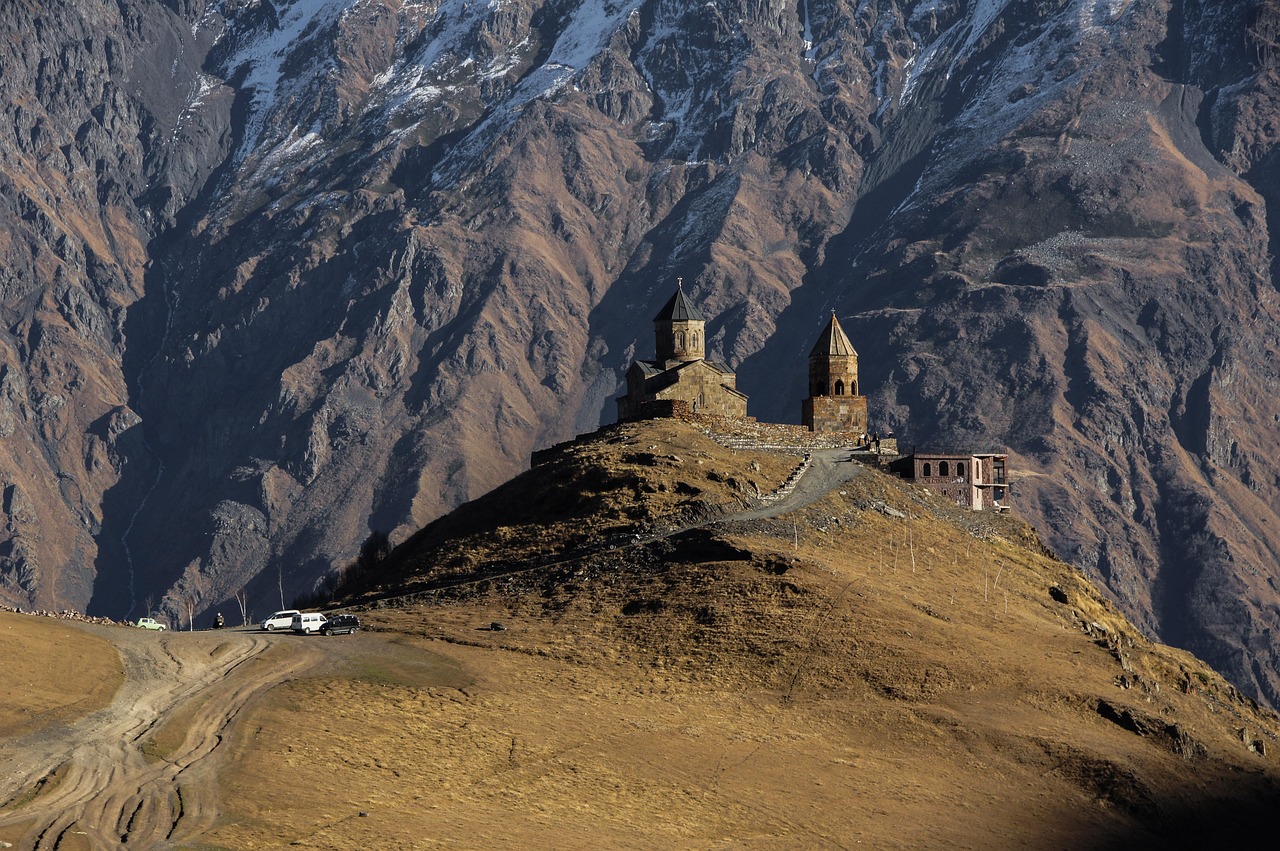
In the north, the road toward Stepantsminda, also called Kazbegi, climbs through the Greater Caucasus to Gergeti Trinity Church, which sits against a snow-covered peak. The ski resort of Gudauri lies along the same route and draws winter-sports visitors. In winter, the Jvari Pass between Gudauri and Kobi can close in blizzards or when the avalanche risk is high, so road conditions should be checked before every journey. A seasonal gondola also links Kobi and Gudauri.
On the Black Sea, Batumi combines a long seafront promenade, modern towers and a botanical-garden landscape. The Argo cable car, the longest in the country, carries passengers high above the city on a ride of about fifteen minutes. It can stop in rain, strong wind or thunderstorms. Inland, Kutaisi serves as the gateway to medieval monasteries and limestone caves.
Markets and bazaars
Georgian markets are best approached as a sensory introduction to local cooking. Dezerter Bazaar in Tbilisi is the main food market, where stalls stack walnuts, dried fruit, cheeses, herbs and pickles in bright, fragrant rows. It is at its liveliest in the morning, and cash is the usual way to pay.
The Dry Bridge market is a flea market held entirely outdoors, with Soviet-era souvenirs, paintings, ceramics and old coins. Rain thins it out quickly, so a dry day is the better choice. For gifts, Meidan Bazaar near the Old Town offers souvenirs, while Bazari Orbeliani is known for gourmet produce and local specialities. Churchkhela, a string of walnuts coated in thickened grape juice, travels well and makes an easy present.
Food and halal dining
Georgian cuisine is rich in cheese, walnuts, fresh herbs and warm bread, and meals are traditionally shared among family and friends. Khachapuri, a cheese-filled bread, appears in several regional forms. The Adjarian version is shaped like a boat and holds a molten centre. Khinkali are large dumplings with a twisted top, traditionally eaten by hand. Mtsvadi, skewered grilled meat, is a staple of family gatherings.
Vegetable dishes deserve equal attention. Lobio is a spiced bean stew, pkhali is a paste of minced greens and walnuts, and badrijani nigvziani is fried aubergine rolled around walnut filling. Dishes such as these are naturally halal, which makes them a comfortable choice for Muslim visitors.
Georgia has no fully developed official halal certification. Most halal restaurants are owned by Turkish, Arab or other Middle Eastern families, and they declare their own status. Tbilisi has more than twenty of them, mainly in the Old Town, along Rustaveli Avenue and in the districts of Marjanishvili and Avlabari. It is sensible to ask staff directly about meat sourcing and ingredients, particularly in traditional restaurants where pork and wine are common. Outside the capital, vegetarian and fish dishes are the simplest option.
Practical tips for getting around
- The Tbilisi metro charges a flat fare per ride. Passengers can use a rechargeable Metromoney card or pay at the gate with a contactless bank card. One tap also covers free transfers between the metro and city buses for 90 minutes.
- Municipal bus 337 links the airport with central Tbilisi and Station Square.
- Ride-hailing apps work in Tbilisi, Batumi and Kutaisi, and they are the practical choice late at night, when the metro has closed. At the airport, the designated ride-hail pickup is a better option than the unlicensed drivers in the arrivals hall, who quote high fares.
- Mountain roads are scenic but slow. Journeys to Kazbegi, Svaneti and other high regions take longer than the distance suggests.
- Churches and monasteries expect modest dress. Covered shoulders and knees are advisable for both men and women.
- Cash is useful in markets, villages and smaller guesthouses, while cards are common in the cities.
Best time to visit
Spring, from April to June, and autumn, from September to November, are the best overall periods, with comfortable temperatures for walking in cities and for countryside drives. July and August form the peak season and offer the best beach weather on the Black Sea coast. For the coast, late September to early October is an especially pleasant window. High-Caucasus hiking is best from June through September. Winter belongs to skiers, who head to Gudauri and other mountain resorts.
Georgia is a country that invites a second visit, because every valley seems to keep one more place set for a guest.
Sources
Featured image: Photo by JLB1988 on Pixabay.
Entry requirements, opening hours, and seasonal conditions can change. Please confirm the details with official sources before you travel.